

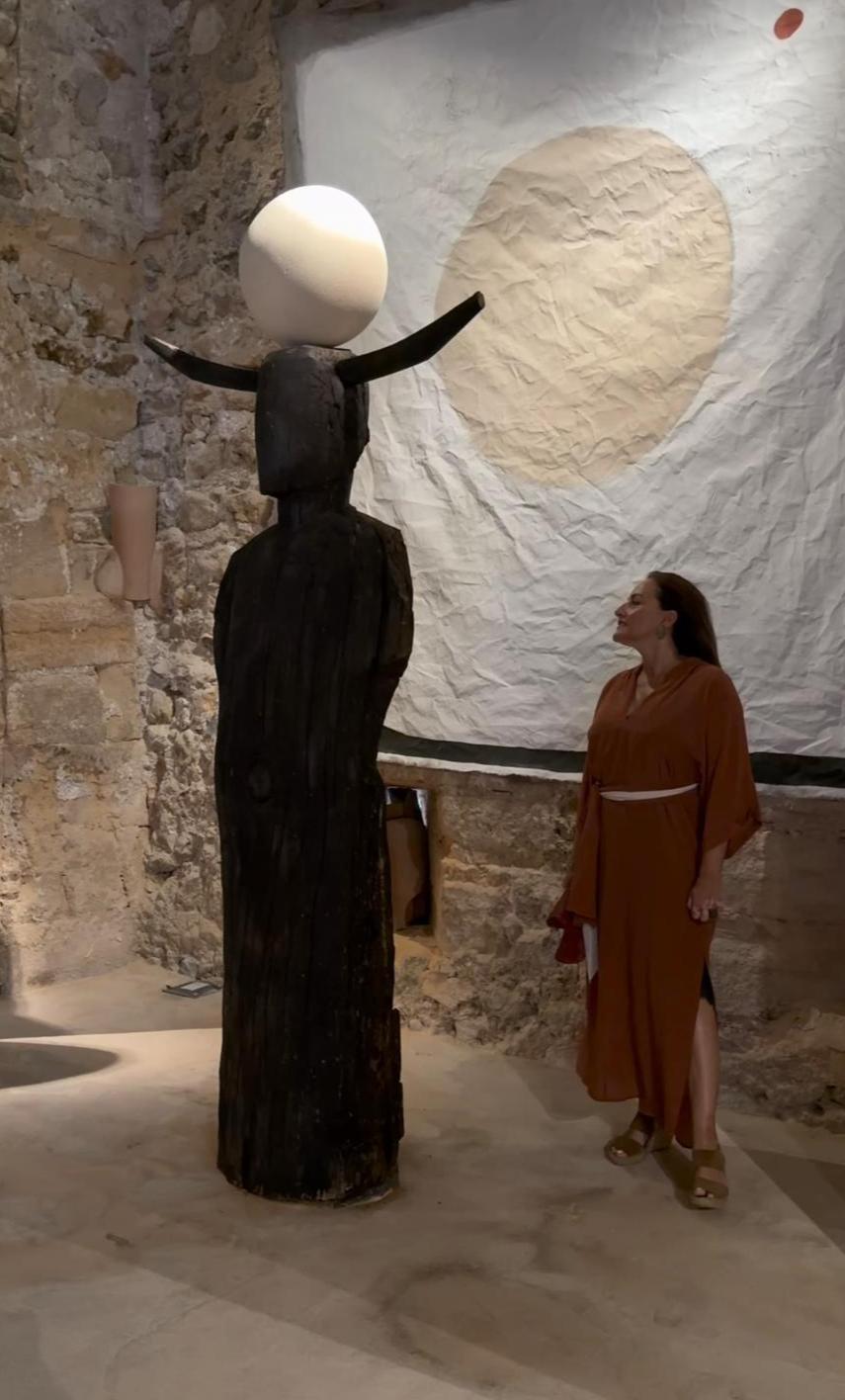
On the occasion of Nit de l’Art, we would like to remind you that Refugi de Bèsties, Jaume Roig’s artistic intervention at the Torre de Canyamel, remains open until 31 October.
An exhibition we had the pleasure of experiencing from its opening and which, at a time when Mallorca once again celebrates its close relationship with contemporary art, deserves to be brought back into focus.
There are places whose presence needs no introduction.
The Torre de Canyamel is one of them.
Built in the 13th century to protect the fertile Canyamel valley, this medieval fortress has remained one of Mallorca’s best-preserved historic buildings. Its stone architecture, the serenity of its spaces and the surrounding landscape make it an essential visit for anyone wishing to discover the island’s heritage from a different perspective.
This summer, that legacy enters a new chapter.
Until 31 October, the Torre de Canyamel hosts Refugi de Bèsties, the new artistic intervention by Mallorcan sculptor Jaume Roig, organised by ABA ART. A project that establishes a natural dialogue between contemporary creation, architecture and landscape.
This is not simply an exhibition installed within a historic building.
It is an intervention conceived specifically for this place.
A conversation between stone, light and matter.
Walking through the Torre de Canyamel, it becomes difficult to distinguish where the architecture ends and the artwork begins.
Jaume Roig’s sculptures, paintings and installations do not simply occupy the space; they seem to be part of it. The centuries-old stone, the Mediterranean light filtering through the small windows and the intimate scale of each room alter the perception of the works, turning the visit into a contemplative and deeply sensory experience.
Each room offers a different perspective.
The works appear and disappear, inviting visitors to pause and transforming the way we perceive a building that many believe they already know.
It is precisely this relationship with the setting that makes Refugi de Bèsties an intervention that could hardly be transferred to another space.
Last weekend, the MallorcaSite team had the opportunity to attend the opening of the exhibition and experience the intervention during its first hours.
Beyond the works themselves, what remained was the atmosphere.
Collectors, art professionals, architects, culture enthusiasts and visitors moved slowly through the fortress as the evening light transformed each room.
There was no rush.
The Torre itself set the pace of the visit.
It is moments like these that remind us that some historic buildings remain very much alive when they find new ways to engage with the present.
For years, Jaume Roig’s work has explored the relationship between nature, memory, instinct and territory.
In Refugi de Bèsties, this artistic language takes on a particularly powerful dimension.
The figures evoke animals, presences and organic forms that draw on an ancestral imagery without imposing a single interpretation. Each visitor establishes a different relationship with the works, shaped by the architecture that surrounds them and by their own experience of moving through the space.
The intervention does not seek to occupy the Torre de Canyamel.
It seeks to listen to it.
The most compelling cultural initiatives do more than present new works.
They also change the way we look at places that already exist.
That is precisely what happens at the Torre de Canyamel.
The exhibition invites visitors to explore the building with a renewed sense of attention, discovering perspectives, volumes and corners that might otherwise go unnoticed during a conventional visit.
The heritage is no longer simply a historic backdrop, but becomes an active part of the experience.
A visit can form part of a day spent exploring the northeast of Mallorca, one of the areas where the island retains a slower pace of life and an identity deeply connected to the landscape.
Nearby are Canyamel beach, the Caves of Artà, the medieval castle of Capdepera and some of the most authentic corners of this part of Mallorca.
It is an experience that brings together contemporary art, heritage, architecture and nature, moving beyond the Mallorca most visitors know to discover a different way of experiencing the island.
Some buildings belong to the past.
Others continue to shape their future.
The Torre de Canyamel demonstrates how heritage can remain alive when contemporary culture finds a way to engage with it with respect and sensitivity.
Refugi de Bèsties does not transform the identity of the fortress.
It reveals it from a new perspective.
And perhaps that is the greatest virtue of this intervention: reminding us that some places never stop evolving, because every generation finds a new way to inhabit them.
C. Illes Balears, 14 – Son Bugadelles
07180 – Santa Ponsa, Mallorca
T.
(+34) 971 712 165
info@mallorcasite.com · mallorcasite.com
Establiment inscrit en el Registre Oficial d'Agents Immobiliaris de le Illes Balears
NÚMERO
DE REGISTRE: GOIBE724048/2024
Members of: